

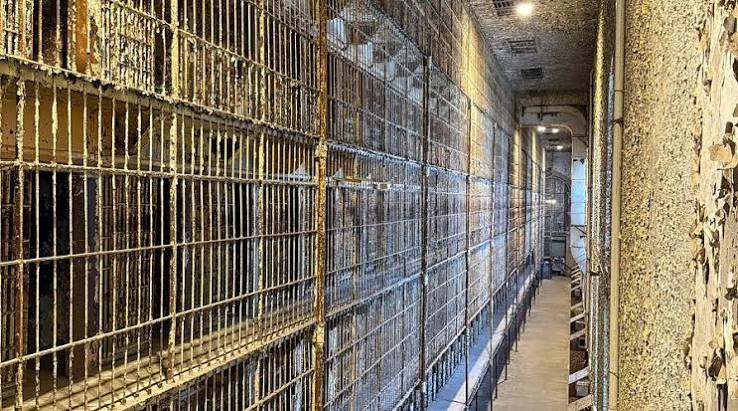
Ohio State Reformatory in Mansfield was commissioned by that state legislature in 1884 as a medium security prison used to house young males that were deemed able to be rehabbed that came from Lancaster Boys’ Industrial School and Columbus State Penitentiary, as the Gilded Age brought about rising concerns of crime and poverty. They aimed to reform young criminals, rather than outright punish them. The prison was constructed in Camp Mordecai Bartley, a prior Civil War training camp for the military. Utilizing several ancient European architectural techniques, local architect Levi Scofield wanted the facility to seem like an imposing German castle or cathedral to inspire spiritual rebirth and moral redemption. Construction began in 1886. However, frequent funding issues pushed back the first inmates moving in for a full decade. Despite being built in stages through the 1910s, the prison technically opened for business in 1896 as the Intermediate Penitentiary. The original intent for medium security was upgraded to maximum, and they wanted to enforce focus on education and trade work. This took the facility into the mid- to late 1900’s. It lasted up until late 1990, when the feds closed it for good because of severe overcrowding and inhumane conditions. However, it was spared from demolition and is still managed today by the Mansfield Reformatory Preservation Society. Arguably its biggest claim to fame is being the site of the 1994 movie The Shawshank Redemption. With its rich history of violence and torture, it’s no wonder that the prison is considered to be the most haunted location in Ohio. Hundreds of reports of deaths have been documented there, and a massive inferno at a nearby facility led Mansfield to house way more prisoners that it was designed to hold. Even still, it remains the largest free-standing steel cellblock in the world.
Haunted Mansfield Reformatory



Good to know